Does Matter Want to Replicate? Replication, Thermodynamics, and the Physics of Evolution
Posted on January 13, 2026 • 4 minutes • 698 words
Table of contents
- Introduction
- Replication Is Not a Fundamental Law of Physics
- The Crucial Context: Non-Equilibrium Systems
- Entropy, Order, and Energy Flow
- Replication as a Thermodynamic Attractor
- Why Replicators Dominate Once They Exist
- Imperfect Copying Changes Everything
- Evolution Is Physics Continuing by Other Means
- Is There Purpose in Replication?
- A One-Sentence Summary
- Implications Beyond Biology
- Closing Thought
Introduction
At first glance, life appears to obey a strange imperative: it replicates.
Cells divide, organisms reproduce, genes copy themselves, and entire ecosystems are shaped by this relentless multiplication.
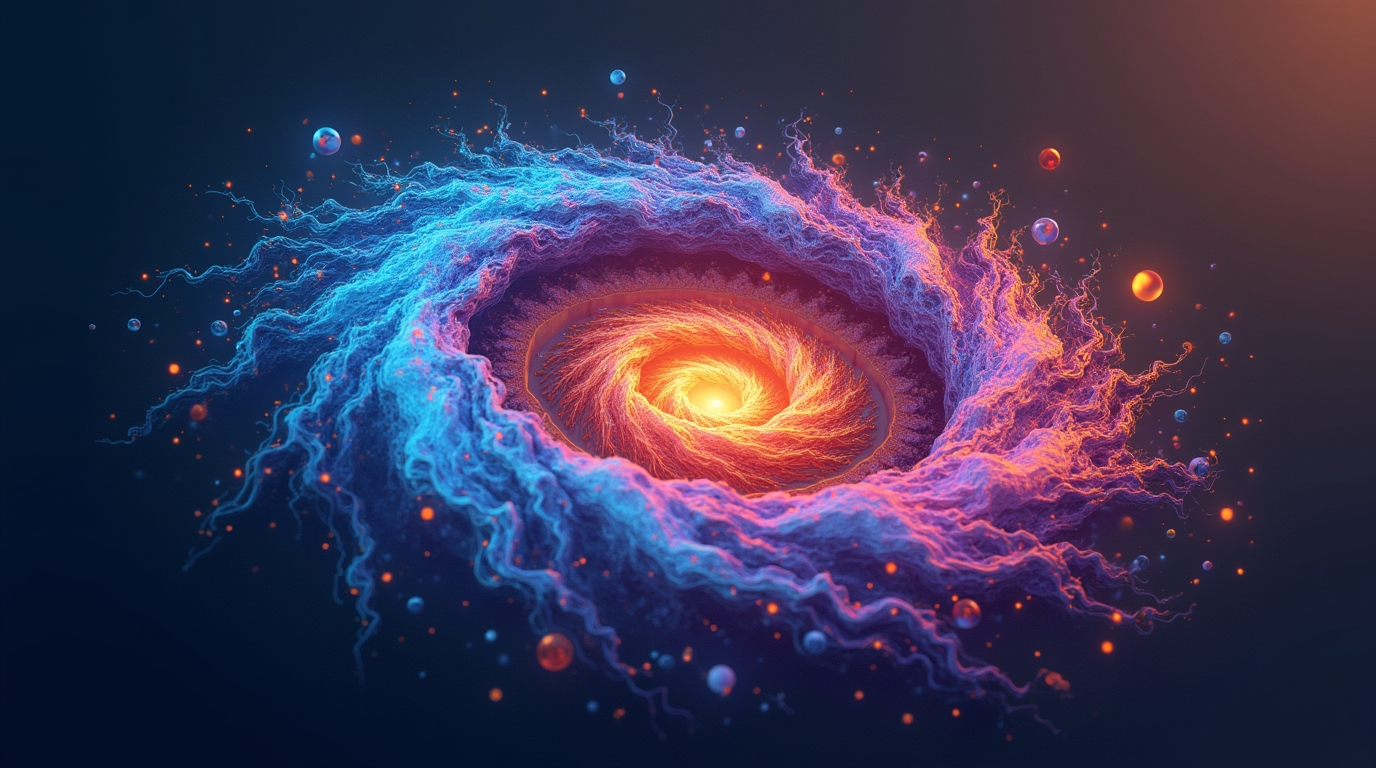
This invites a deep question:
Is replication a fundamental principle of nature? Does matter itself tend to copy itself? Or is replication merely an accident of biology?
Surprisingly, modern physics suggests a subtle but powerful answer:
replication is not a fundamental law — but once possible, it becomes statistically inevitable.
Replication Is Not a Fundamental Law of Physics
Physics is built on a small number of foundational principles:
- Conservation laws (energy, momentum, charge)
- The principle of least action
- Quantum dynamics
- The laws of thermodynamics
None of these state or imply that matter must replicate.
There is no equation of motion that says “this structure should make a copy of itself.”
No constant of nature encodes reproduction.
Replication is therefore not fundamental in the way gravity or electromagnetism is.
The Crucial Context: Non-Equilibrium Systems
Replication only appears in systems that are:
- Far from thermodynamic equilibrium
- Driven by continuous energy flow
- Chemically or structurally complex
- Subject to noise and fluctuations
Examples include:
- Prebiotic chemical environments
- Living cells
- Ecosystems
- Technological and informational systems
In equilibrium, nothing replicates.
Crystals form, gases mix, entropy maximizes — and the story ends.
Replication belongs exclusively to driven systems, not static ones.
Entropy, Order, and Energy Flow
A key insight was articulated by Erwin Shroedinger in What Is Life?:
Living systems maintain order by exporting entropy.
This is often misunderstood as life “resisting entropy.”
In fact, life accelerates total entropy production by using energy gradients efficiently.
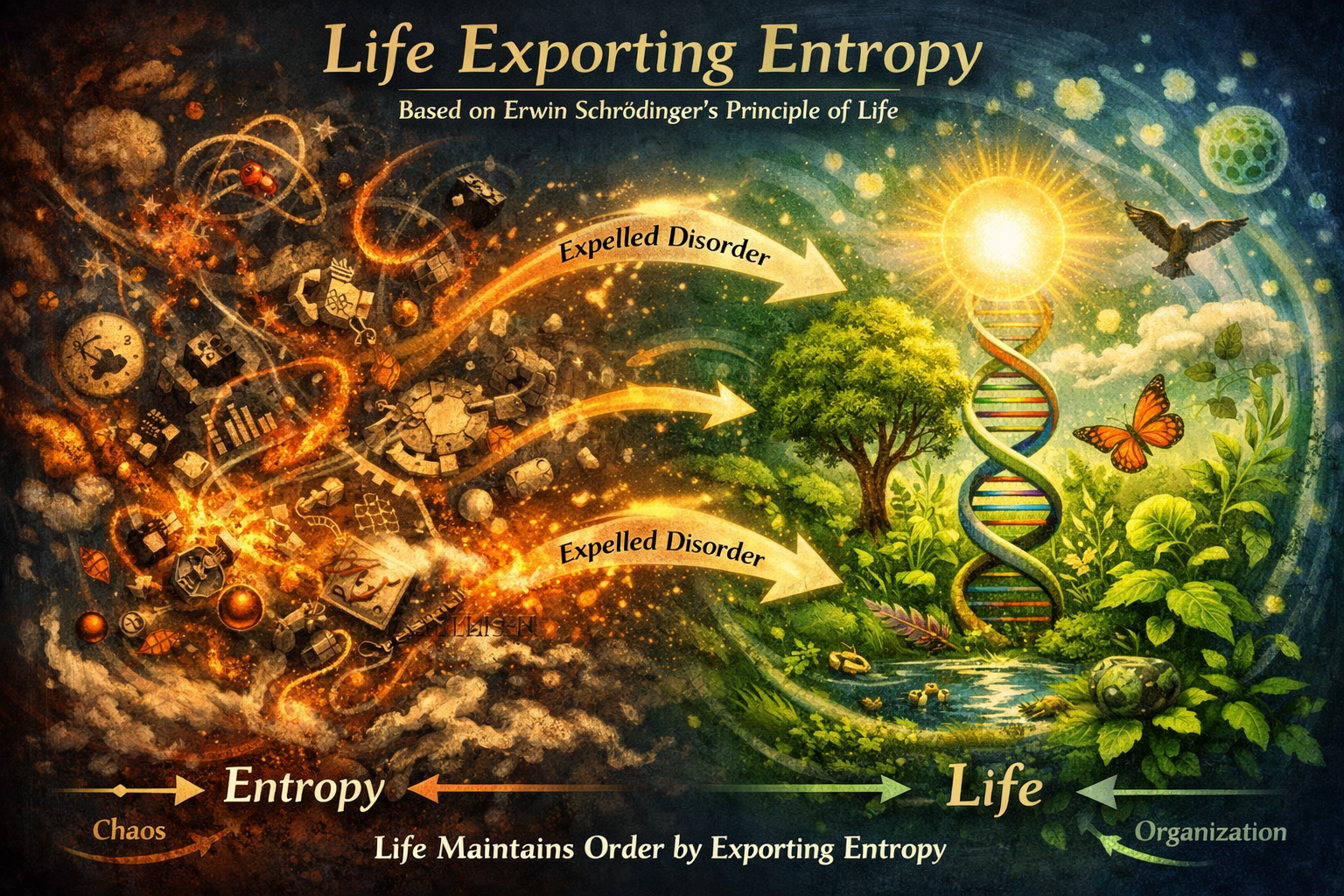
Replication turns out to be one of the most effective ways to do this.
Replication as a Thermodynamic Attractor
In modern non-equilibrium thermodynamics, replication is understood not as a goal, but as an attractor state.
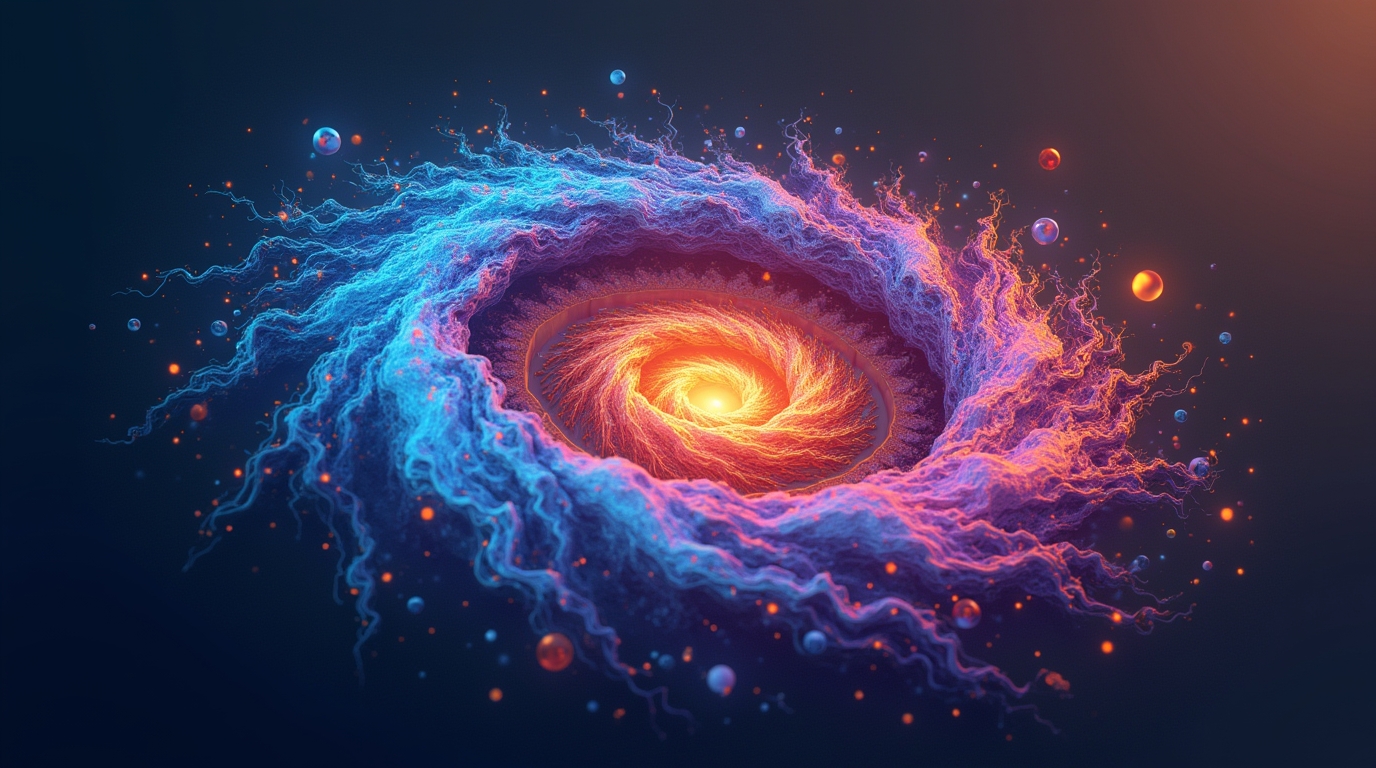
The logic is simple:
- Energy gradients drive chemical reactions
- Some reaction networks accidentally form self-templating structures
- These structures catalyze their own production
- More copies mean more energy dissipation
- Systems statistically drift toward states that dissipate energy more effectively
Replication is selected, not commanded.
Why Replicators Dominate Once They Exist
Consider two structures in a driven system:
- One that does not replicate
- One that makes imperfect copies of itself
Over time:
- The non-replicator remains singular
- The replicator multiplies
- The replicator occupies more of the system
- The replicator processes more energy
Nothing “wants” this to happen — it happens because it is statistically favored.
Persistence through copying beats persistence through mere stability.
Imperfect Copying Changes Everything
Once replication exists, perfect copying is impossible.
Thermal noise, quantum uncertainty, and chemical fluctuations guarantee variation.
Add one more condition:
- Limited resources
And a remarkable result follows:
Evolution becomes unavoidable.
Replication + variation + competition
→ Differential replication
→ Selection
→ Evolution
No genes are required.
No cells are required.
No life is required.
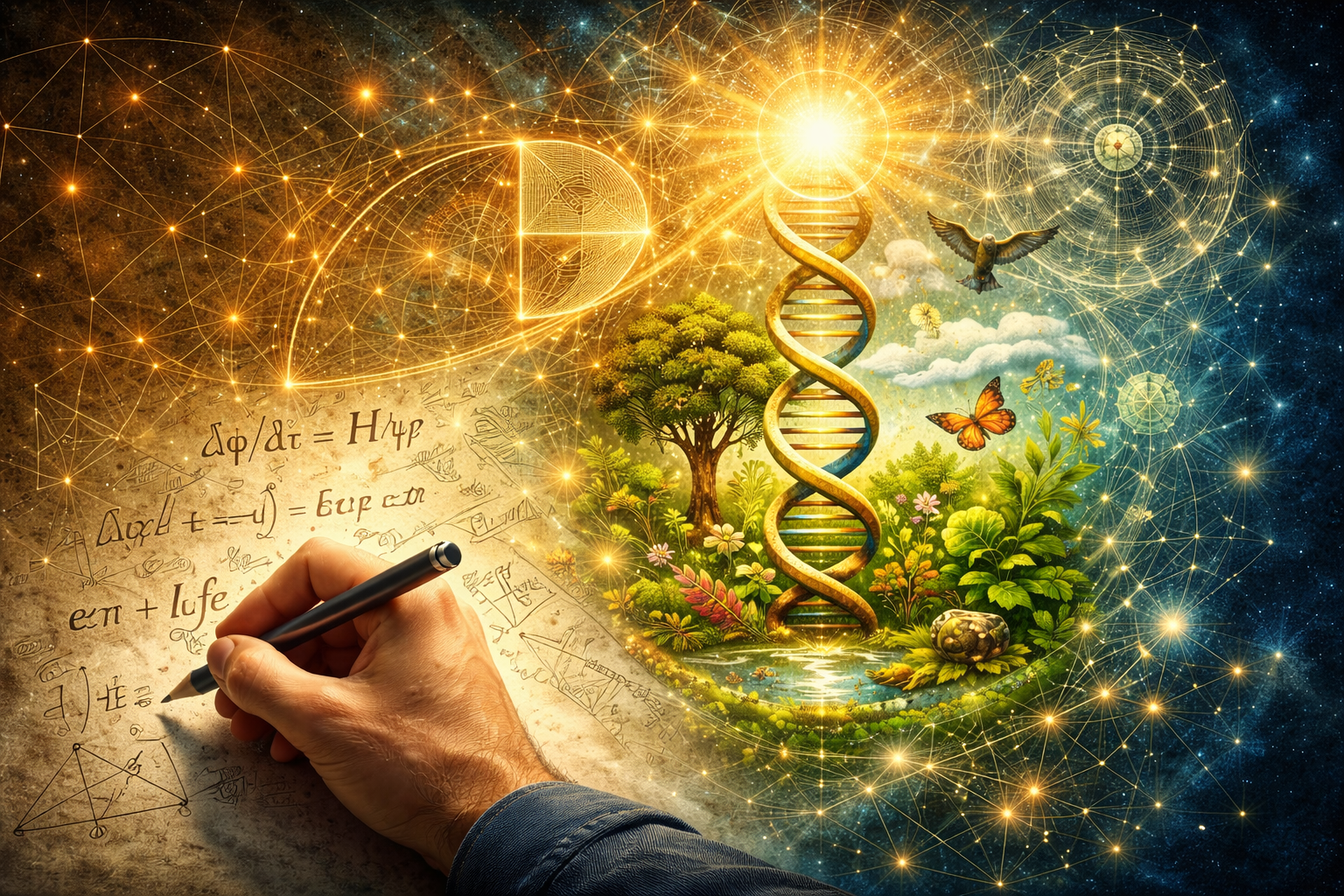
This is a mathematical consequence, not a biological assumption.
Evolution Is Physics Continuing by Other Means
From this perspective:
- Biology does not introduce a new principle
- Life does not violate physics
- Evolution is not special
Instead:
Evolution is what non-equilibrium physics looks like when replication appears.
Natural selection is not a force — it is a statistical filter acting on replicators in noisy environments.
Is There Purpose in Replication?
It is tempting to speak of goals:
- Survival
- Fitness
- Reproduction
But physics offers a colder explanation.
Replication persists because:
- It is robust under perturbation
- It resists extinction by multiplication
- It amplifies structures that already exist
Purpose is an interpretation added afterward — not a driver.
A One-Sentence Summary
Matter does not strive to replicate, but in energy-driven systems, replicating structures are statistically inevitable — and evolution is the mathematical consequence of that inevitability.
Implications Beyond Biology
This framework applies to:
- Prebiotic chemistry
- Artificial life
- Cultural evolution
- Information systems
- Possibly advanced AI ecosystems
Wherever copying under energy flow exists, selection follows.
Life is not an exception in the universe.
It is what the universe does when conditions allow.
Closing Thought
Replication is not written into the laws of nature.
But once the door opens, physics walks through it without hesitation.
The universe does not intend to create life —
yet life is what happens when thermodynamics is given enough time.
Share


Tags
Counters
